
Chin Filler Treatment: What to Expect and How It Works
Chin Filler Treatment: What to Expect and How It Works

Chin filler is a non-surgical treatment that uses injectable dermal filler to add projection, shape or length to the chin, usually in a single visit of well under an hour. Done well, it comes down to three things: a face assessed as a whole, the right filler type for the job, and a licensed medical professional who knows the anatomy. That is why we start every filler plan with a personal consultation at Facial Mania Med Spa, before anyone picks a product or a syringe count.
This guide walks through what chin filler can change, which products are used, what happens at the consultation and the injection visit, how long results last, and the safety points worth knowing before you book.
TL;DR
- Chin filler is a minimally invasive way to improve chin projection or shape and to balance the lower third of the face, with results you can see right after the visit.
- Hyaluronic acid (HA) is the most commonly used filler type: it lasts roughly 3 to 12 months and can be reversed. Heavier, firmer products are often chosen for the chin because they hold structure.
- The FDA approves absorbable fillers for chin augmentation in adults 22 and older, and recommends a licensed, trained provider.
- Expect a consultation covering your goals and medical history, then about 15 to 30 minutes of injecting, with mild swelling or bruising as the usual after-effects.
- Call for urgent care if you notice unusual pain, vision changes, or white, gray or blue skin near the injection site.
Table of Contents
- What chin filler actually does
- Is chin filler right for you?
- Which filler goes in the chin
- What happens at the consultation
- The injection appointment, step by step
- Results: what you see and how long it lasts
- Side effects and safe use
- Getting started with us
- Our perspective
- FAQ
- Sources
What chin filler actually does
A chin that sits slightly back from the rest of the face (called retrusion) can make the nose look larger, the jawline look softer, or the lower face look short and rounded. Chin filler places volume where the chin needs it. According to the maker of one widely used chin product, Restylane Defyne is indicated to temporarily correct mild-to-moderate chin retrusion, which can also soften the look of a double chin and balance the lower third of the face.
The treatment tends to address a handful of concerns:
- Projection: moving the chin forward so the profile looks more balanced.
- Length: adding height at the bottom of the chin so a short lower face looks more proportioned.
- Shape: refining width or point, for a more rounded, pointed or broad chin.
- Lines near the chin: softening a deep crease under the lower lip or marionette lines at the corners of the mouth.
The last two matter because the chin rarely acts alone. A Galderma Aesthetics explainer on facial balance describes dividing the face into horizontal thirds: when the lower third is short, the face can read as round and full, and chin filler can elongate it. The same piece notes that the common profile guideline, the Ricketts line, was developed on Caucasian faces and may not apply to everyone, which is one reason a good provider looks at you rather than at a formula.
Is chin filler right for you?
Chin filler tends to suit people who like their face overall but want a more defined or balanced profile, and who would rather not have surgery or downtime. It is best matched to mild-to-moderate retrusion, the indication in the product information above. Adults 22 and older are the group for which the FDA lists approved absorbable fillers for chin augmentation.
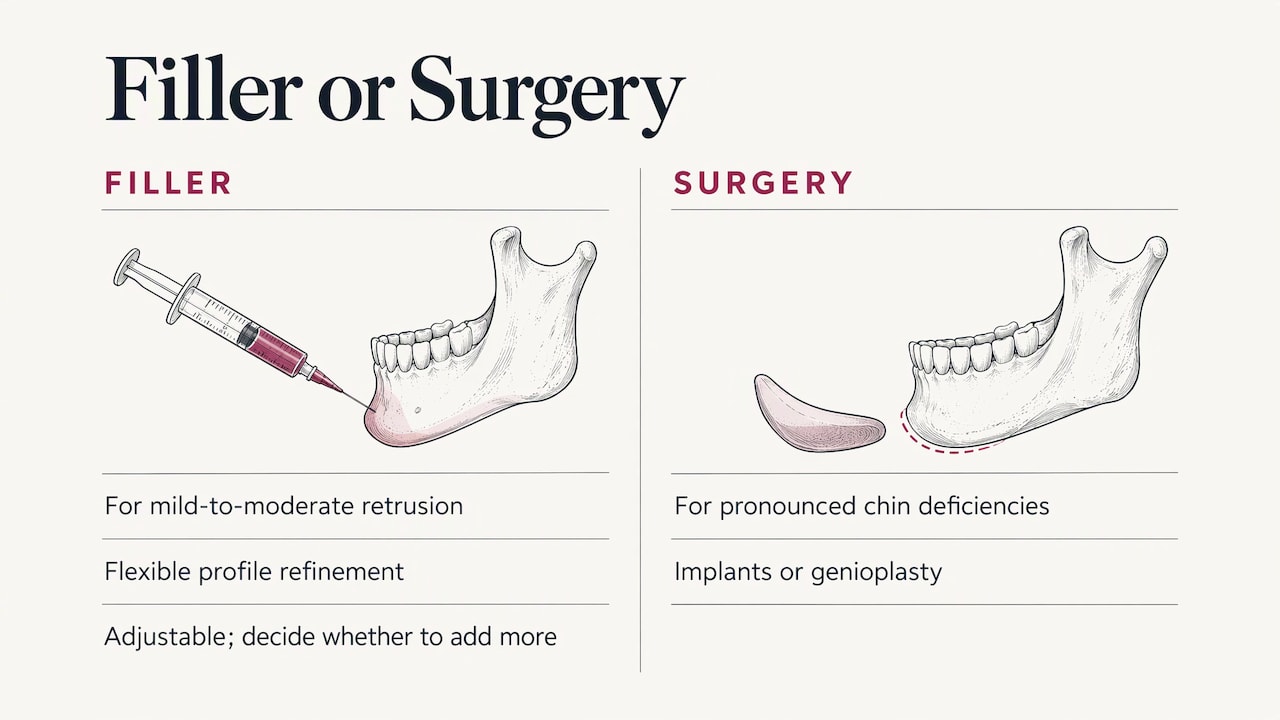
If you have a larger structural difference, the consultation is where that gets sorted out honestly. A 2023 academic review explains that surgical implants or genioplasty are frequently used for more pronounced horizontal chin deficiencies, while filler is the flexible option for refinement and balance. Because filler is adjustable, many people like that they can see the change, live with it, and decide whether they want more.
Skin quality around the lower face is a separate topic from volume. If you are also thinking about firmness and texture, a guide to restoring collagen in your face covers the skin-care side, and your consultation can fold both into one plan.
Which filler goes in the chin
You do not need to memorize product names, but it helps to know the four families, because your provider will choose among them.
| Filler family | Typical duration | Good to know |
|---|---|---|
| Hyaluronic acid (HA) | About 3 to 12 months | Most commonly used; minimal immune reaction; no allergy test needed; reversible |
| Calcium hydroxylapatite (CaHA) | About 9 to 12 months, at least a year in most patients | Favored when skin is thick and the goal is defining bony structure |
| Poly-L-lactic acid (PLLA) | Up to 2 years | Works by stimulating the body’s own collagen, so effects build gradually |
| PMMA | Permanent | Requires allergy testing; not recommended for the chin |
The durations and characteristics come from a 2023 academic review of fillers for the chin and jawline. The same review notes that permanent fillers are not a good fit here, and the FDA states that permanent fillers are approved only for nasolabial folds and cheek acne scars.
Why firmer HA is the usual choice
HA fillers are graded by how firm they are, a property called G-prime. A 2023 practical guide to selecting facial fillers explains that firmer, higher G-prime products are recommended for injection deep against the bone to build structure, because they would feel hard and lumpy if placed more superficially. In a 2024 international consensus, all 11 expert advisors preferred a high G-prime HA for the chin, the only facial region where they agreed unanimously. Softer HA can be layered on top for soft-tissue contour.
In plain terms: the chin is a structural area, so the product is usually firm and placed deep, and that is a decision made face to face at your consultation, not from a menu.
Needle or cannula
You may hear both words. A needle is a sharp, fine tip; a cannula is a blunt, flexible tube. The same consensus group notes that a needle is generally easier for the chin because it is hard to keep a cannula in the right plane along the chin’s curve, while other clinicians favor a blunt cannula for safety reasons. Either way, the technique is the provider’s call and should be explained to you.
What happens at the consultation
The consultation is the most important part of chin filler, and it is why our approach starts there. Expect these steps:
- A look at your face and goals. Your provider studies your profile and proportions, not just your chin. You describe what you see in photos and the mirror, and what you want to change.
- Your medical history. Providers typically ask about allergies, a history of bruising or bleeding after similar procedures, neurological problems and skin conditions. Tell them about every medication and supplement, including blood thinners, and about any recent dental work or filler elsewhere on your face.
- A recommendation. That covers the filler type, how much to start with, and whether other areas such as the jawline or lips should be part of the plan.
- Time to decide. You should leave knowing the plan and the aftercare, not rushed into a syringe.
A useful habit is to bring two or three photos of your face from the side, in natural light, and one reference of the balance you like. It gives the conversation something concrete to work from.
Our injectables are given by licensed medical professionals, and the injectable tier of our menu works under a medical director. If you are also curious about lips, cheeks or Sculptra, the same visit can cover the whole picture, since we offer skin care, laser, body treatments and injectables under one roof.
The injection appointment, step by step
The American Academy of Dermatology notes that most filler treatments take 15 to 30 minutes in a single office visit. For the chin, the usual flow is:
- Prep. The skin is cleaned and marked. Ice, a numbing cream or a nerve block may be used for comfort.
- Injection. Filler is placed in a few small deposits. The AAD says you may feel stinging or burning for a moment.
- Shaping. Your provider may gently mold the area and check your profile from the front and side.
- Aftercare. The AAD advises avoiding touching the treated area for three days unless you are told to massage it. Your provider will give you instructions specific to your product.
Providers often go gradually. A 2024 review on profile contouring recommends starting with lower volumes in the chin to avoid excess pressure in tight tissue, then adding more at a second visit if you want it. That is a sensible approach to share with your provider: a conservative first session keeps the result natural, and you can always build.
Results: what you see and how long it lasts
The change in projection is visible straight away, though swelling can make the chin look slightly larger for the first days. The final look settles as swelling goes down.
Here is what the evidence says about outcomes:
- In an 18-month open study of HA filler, 77.8% of patients improved by at least one grade on a four-point volume-loss scale for the chin, and 95.0% were satisfied at final follow-up.
- A December 2025 meta-analysis of 24 articles covering 2,259 patients found satisfaction rates of 89 to 94% at 6 to 12 months, with a mean duration of effect of 5 to 12 months.
- Mayo Clinic notes that FDA-approved fillers last about a year when used for contouring.
So plan on the range of roughly 6 to 12 months for HA in the chin, with individual variation. Many people book a touch-up before the result has fully faded, which keeps the look steady and often means a smaller top-up than starting from scratch. If you are a regular injectables client, our monthly memberships (Amber, Topaz and Diamond) are designed for ongoing care; ask at your consultation how they fit with your plan.
Side effects and safe use
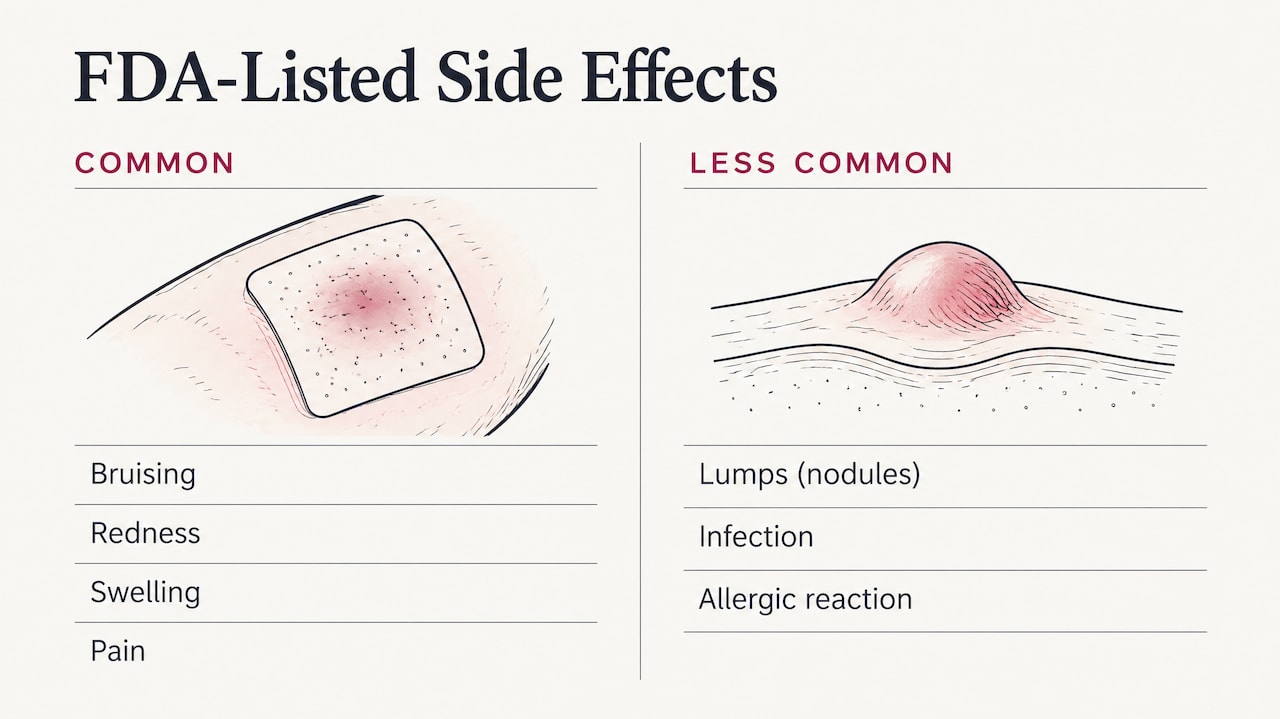
Most people have mild, short-lived effects. The FDA lists bruising, redness, swelling, pain, tenderness, itching and rash as the common risks. Less common ones include lumps (nodules), infection and allergic reaction. The 2023 chin review adds that because the skin over the chin is thicker than in other parts of the face, contour irregularity is not commonly seen after chin filler.
The 2025 meta-analysis found only one study reporting a serious complication among all the chin patients reviewed, which is why choosing an experienced injector matters so much.
Know the warning signs
The rare serious risk is filler entering a blood vessel. The FDA says that can cause tissue death, vision changes including blindness, or stroke. It explains in its August 2025 panel summary that this happens when filler reaches an artery and travels toward the eye or brain. The chin has its own artery to respect: the 2024 profile review points to the ascending mental artery, which enters roughly 6 mm from the midline, and is one reason anatomy knowledge counts.
Get immediate medical attention, and tell the treating provider, if during or shortly after treatment you have:
- unusual or severe pain,
- changes in your vision,
- white, gray or blue skin near the injection site, or
- any sign of stroke, such as facial droop, weakness or trouble speaking.
Practical safe-use tips
- Choose a licensed, trained provider. The FDA recommends one experienced in dermatology or plastic surgery, and advises against self-injection or buying filler online.
- Read the patient labeling for the specific filler you receive.
- Share your full medical history, particularly bleeding or bruising tendencies and allergies.
- If you are pregnant or breastfeeding, or have an active skin infection near the chin, raise it at your consultation so your provider can advise you on timing.
Getting started with us
If you want to explore chin filler, our dermal filler team starts with the consultation: your face, your goals, your history, and a plan tailored to you. You can read about the treatment on our dermal fillers page or look at a location near you, including Boca Raton, West Palm Beach and Plantation. Pricing is discussed at your consultation, and we offer payment plans through Cherry as well as monthly memberships.

Want a profile assessment before you decide anything? Book a dermal filler consultation and we will map out what would, and would not, make sense for your face.
Our perspective
Chin filler works best when it is treated as part of the whole face, not as an isolated fix. We see the chin as the anchor of the lower third: a small, well-placed change can sharpen a profile, balance the nose and lips and make the jawline read more clearly.
That is why we begin with a conversation. Our approach centers on a personal consultation and a plan tailored to each person, and our practitioners keep up with continuing training so that the technique and product choice match the face in front of them.
We also like that a complete menu sits under one roof. If your consultation shows that the best result combines chin filler with jawline or cheek support, Sculptra, skin care or a laser treatment, you can plan it all in one place, and a monthly membership can keep that plan consistent over the year.
Our advice: start modestly, look at your profile again in a couple of weeks, and build from there. The best chin result is the one people notice as you looking well rested and balanced, never as a procedure.
The Facial Mania Med Spa Team
FAQ
How long does chin filler last?
HA chin filler typically lasts about 3 to 12 months, and a 2025 meta-analysis found a mean effect duration of 5 to 12 months. Firmer products placed deep tend to hold up well, and your provider can tell you what to expect for the product they choose. Many people schedule a top-up as the result starts to soften.
Does chin filler hurt?
Most people describe brief stinging or pressure. Providers may use ice, a topical numbing cream or a nerve block to keep you comfortable. Mild tenderness, swelling or bruising afterward is common and usually passes within days.
Can chin filler be reversed?
HA filler is reversible, which is one reason it is the most commonly used type. An enzyme can dissolve it if you are unhappy with the result or need it removed for medical reasons, and your provider can explain how that works. Other filler types do not offer the same option, so product choice matters.
Can chin filler help a double chin or chin crease?
It can help in some cases. Restylane’s product information notes that correcting mild-to-moderate chin retrusion may reduce the look of a double chin, and chin filler can also soften the crease below the lower lip. Whether it is the right option for your anatomy is something to settle at your consultation.
Is chin filler safe?
The FDA approves absorbable fillers for chin augmentation in adults 22 and older, and the most common effects are mild and temporary. Serious complications are rare but real, so the FDA recommends a licensed, trained provider and urgent care for unusual pain, vision changes or discolored skin near the injection site.
Sources
- Restylane: chin treatment area
- Galderma Aesthetics: how to balance your looks with a chin filler
- Using injectable fillers for chin and jawline rejuvenation (PMC, 2023)
- A practical guide to selecting facial fillers (Journal of Cosmetic Dermatology, 2023)
- Simplifying the injector’s armamentarium: an international consensus (2024)
- Cleveland Clinic: dermal fillers
- American Academy of Dermatology: fillers FAQs
- Mayo Clinic: facial fillers for wrinkles
- Evaluate clinical outcome, patient satisfaction, and safety of HA chin augmentation (JAMPBR, 2025)
- FDA Executive Summary, General Issues Panel Meeting (August 2025)
- Profiloplasty and facial contouring with injectables (PMC, 2024)
- How to restore collagen in the face naturally